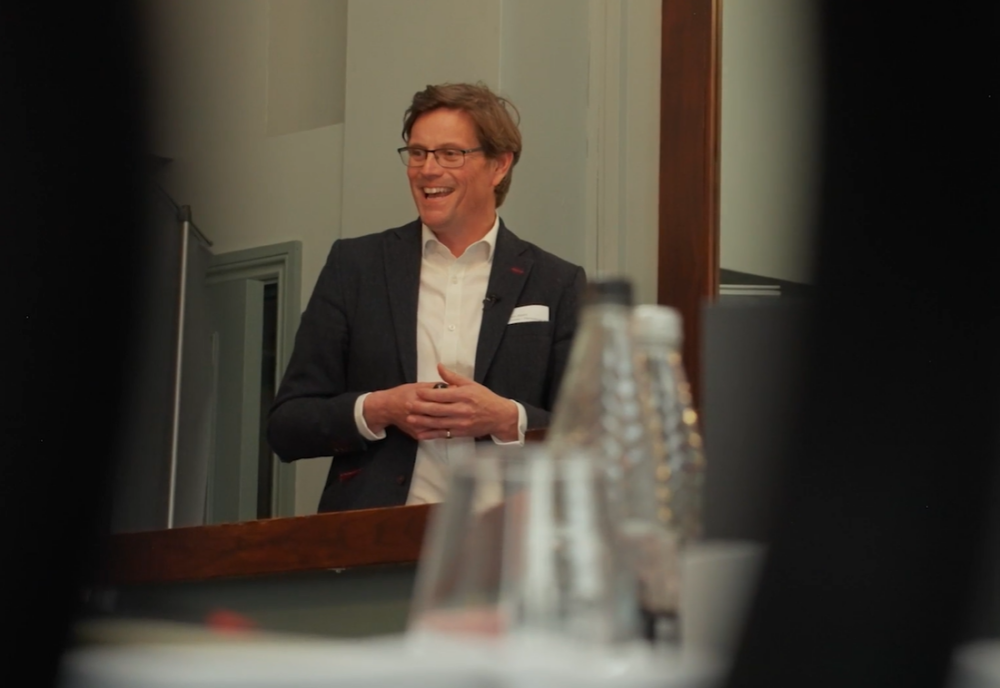
Our 4th annual Connect event
There’s no shortage of conversation about AI in partner marketing. What’s harder to find is a clear view of what’s actually changing inside teams that are responsible for delivering growth, and what isn’t.
That’s what made our latest Coterie Connect IRL Event in London worth paying attention to.
This wasn’t a room exploring ideas at the edges. It was a room of senior partner marketing leaders working inside complex ecosystems, dealing with real commercial pressure. Alongside them were specialists in behavioural science, decision-making and AI-led execution. The conversation moved quickly past use cases and into something more grounded. Where AI is working, where it isn’t, and what still needs to change.
Ahead of the event, we asked two simple questions. Where is AI making a difference, and how is it actually being viewed inside partner marketing teams?
The responses were pretty consistent.
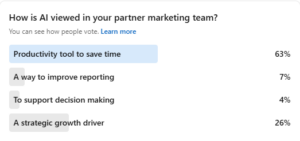
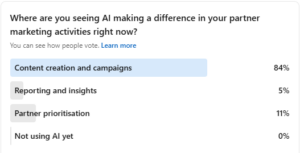
Most teams are seeing impact in content creation and campaign execution. Most still see AI primarily as a productivity tool. A smaller group are starting to view it as a driver of growth. Very few associate it with reporting or insight, and only a small number see it playing a role in decision making.
That sets the context.
AI is improving output. Growth isn’t keeping up.
There wasn’t much debate in the room about where AI is delivering value.
It’s speeding up the operational side of partner marketing. Content is easier to produce. Campaigns are easier to scale. Teams are getting more done, more quickly. That progress is real.
What people are questioning is how much of that activity is actually translating into growth.
More output doesn’t automatically mean better outcomes. And as teams push AI further into their workflows, that gap is becoming harder to ignore.
At its core, the issue hasn’t really changed. Partner growth is shaped by decisions. Where to focus. Which partners to prioritise. When to invest. Those decisions are still being made in much the same way.
Most partner decisions are still made in the dark
One of the more uncomfortable themes that came through was just how limited visibility still is across partner ecosystems.
Inside partner organisations, priorities shift all the time. Decisions are being made about which vendors to focus on, which campaigns are worth the effort, and where time and resource actually go. Most of that never shows up in reporting, but it has a direct impact on whether programmes gain traction.
Jonathon Bates brought that into focus in a very practical way. Many organisations are still making forward-looking investment decisions based on historical performance and structured reporting. That gives you a baseline, but it doesn’t tell you what’s changing right now.
It also explains why things don’t always land as expected. Two partners can look identical on paper and behave very differently in reality.
What’s starting to shift is how some teams are approaching this. They’re looking at signals like hiring activity, customer demand and patterns of engagement to get a better sense of where momentum is building.
Behaviour still drives the outcome
Even with better signals, the conversation kept coming back to something more fundamental. Partner ecosystems are shaped by people.
Dr Paul Marsden framed this clearly. Decisions are influenced by trust, perceived risk, effort and internal priorities. None of these are easy to measure, but they consistently determine whether a partner chooses to act.
That’s where a lot of the current gap sits.
AI is being used heavily on execution, but much less on understanding behaviour or improving judgement. Teams are moving faster, but often with the same assumptions they’ve always had.
There’s a real opportunity here to use AI differently. To challenge thinking, explore perspective and bring more structure to decisions that are often made with incomplete information.
Execution breaks down at alignment
When the conversation moved into execution, it felt very familiar. Most teams don’t struggle with ideas. The challenge is turning those ideas into plans that are aligned and actually get delivered.
Different stakeholders see things differently. Context gets lost as work moves between teams. Plans change shape along the way, and not always for the better.
Barnaby Wood focused on how AI can help here, but not in the way people often expect. It’s less about generating more content and more about bringing structure to how plans are built in the first place.
Clearer inputs, shared understanding, better alignment earlier on. That’s where things start to move more smoothly.
The shift is already happening
By the end of the day, there was a clearer sense of where things are heading.
Teams are starting to move away from static views of partner performance and towards something more dynamic. There’s more attention on timing, relevance and context, and less reliance on broad distribution alone.
There’s also a more grounded view of scale. Reaching more partners isn’t the goal in itself. What matters is whether what you’re doing actually connects with partners in a way that drives action.
If you’re working through this, you’re not alone
What stood out most wasn’t just the content of the sessions, but the nature of the conversation.
These are teams already using AI in live programmes. They’ve moved past the early experimentation phase. The questions they’re asking now are more demanding. Why isn’t this converting? Where are we misallocating investment? What are we still not seeing?
There aren’t simple answers.
What is clear is that the next phase of AI in partner marketing is going to be shaped by how it’s applied to decision-making. Better visibility. Better prioritisation. A clearer understanding of how partners actually behave.
If these are the challenges you’re working through, it’s a conversation worth being part of.